
G20 Summit Event | Video | The Knowledge Portal
Alasdair Currie
At the G20 in Indonesia, our director Omar Shaikh spoke to Shrey Kohli, Head of Debt Capital Markets at London Stock Exchange Group, and Hitesh Asarpota, Head of Global Capital Markets & Loan at Emirates NDB about green sukuk, and the work of the High-level Working Group on Green Suku, which was launched at the COp26 summit in Glasgow.

7th World Investment Forum - Green Islamic Finance (Green Sukuks) | Video | The Knowledge Portal
Alasdair Currie
Islamic finance has witnessed a rapid growth in recent years. In 2019, the value of Islamic banking assets was estimated to be around USD 1.99 trillion. Within this area of finance is growing interest in environmentally themed products. “Green Sukuk” are Shari’ah compliant investments in renewable energy and other environmental assets. Proceeds are used to finance construction, to refinance construction debt, or to finance the payment of a government-granted green subsidy. They may involve securitizing future income cash flows from ring-fenced projects or assets with specific criteria attached.
UKIFC Indonesia Report | Market Report | The Knowledge Portal
Alasdair Currie

In 2015, the United Nations (UN) established a blueprint for addressing economic, social, governance, and environmental challenges – the Sustainable Development Goals (SDGs). It is estimated that funds of up to US$7trn are required on an annual basis for initiatives aligned to the SDGs.
World Bank Report | Market Report | The Knowledge Portal
Alasdair Currie
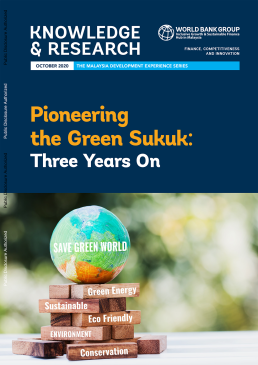
July 27, 2020, marked the 3-year anniversary of the first green sukuk issuance, and there has been tremendous progress in the adoption of the green sukuk as a key capital market instrument to fund environmentally friendly projects. There is widespread awareness, greater technical capabilities in the markets that have embraced the green sukuk, and market-driven product innovation pushing the envelope.
HSBC UN Sustainable Development Goals Bond and Sukuk Report 2022 | Market Report | The Knowledge Portal
Alasdair Currie

A bank like ours has a responsibility to lead on climate change. We’re global; we seek to help finance the future, but also we’re present across emerging economies where the transition will be the toughest, where there’s a heavy reliance on fossil fuels. It is our ambition to achieve net zero by 2050 and support our customers in their transition to a sustainable future with 750 billion to 1 trillion US dollars of sustainable finance and investments.’
Celine Herweijer, Group Chief Sustainability Officer, HSBC
GCC SUKUK: A PRIMER Investment Characteristics of US Dollar-Denominated Sukuk Originating from the Gulf Cooperation Council 2022 | Market Report | The Knowledge Portal
Alasdair Currie
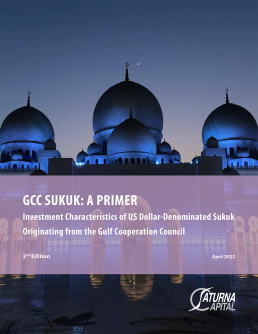
This 2nd edition GCC Sukuk Primer provides an overview of the investment landscape and characteristics of Islamic-compliant investment certificates, commonly referred to as sukuk, a market niche that continues to evolve. We
will cover the risk and return attributes of sukuk and explore their relationship to changes in the price of oil, since hydrocarbons largely drive sukuk issuers’ economies. Our scope is limited to US dollar-denominated sukuk, primarily
originating from members of the Gulf Cooperation Council (GCC), a collective coalition that comprises Bahrain, Kuwait, Oman, Qatar, Saudi Arabia, and the United Arab Emirates (UAE).
IIFM Sukuk Report 2022 | Market Report | The Knowledge Portal
Alasdair Currie
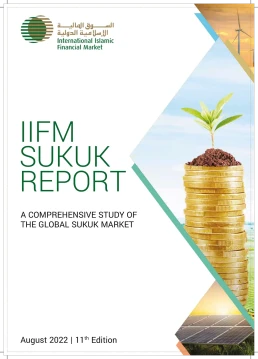
This research report scrutinizes the International and Domestic Sukuk market developments, structural preferences and other relevant factors based on verified Sukuk issuance data with particular focus on the year 2021. As the case previous year, Sukuk market maintained its positive growth trajectory and posted yet another record year of issuances which evidently put Sukuk as one of the main driving force of the industry though 2021 has being a challenging year due sharp rise in commodity prices particularly Oil and inflationary pressure on global economy.
Ministry of Finance Indonesia Green Sukuk Allocation and Impact Report 2023 | Market Report | The Knowledge Portal
Alasdair Currie
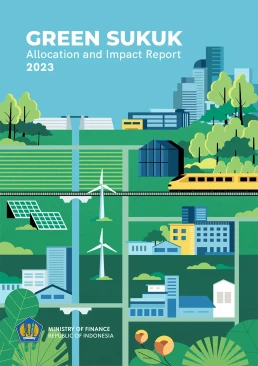
Since its Green Sukuk debut in 2018, the Republic of Indonesia has not only succeeded to enter the market as the world’s first sovereign Green Sukuk issuer, but have also finally issued the fifth Global Green Sukuk in 2022, accumulating the proceeds at USD 6.9 billion. The 2022 Global Green Sukuk issuance marked several notable achievements amidst the volatile global economy, including the largest Green Sukuk tranche ever printed globally and the first Green Sukuk tranche in 10-year maturity by the Republic of Indonesia. In addition, the Republic issued its inaugural Project-based Green Sukuk and Retail Green Sukuk (ST 009) for the domestic market in the same year. These thriving Green Sukuk issuances have consolidated Indonesia to steadily and consistently develop various non-state budget climate financing instruments.
Infracorp | Technical Case Study | The Knowledge Portal
Alasdair Currie
Infracorp
Issues Bahrain’s first-ever green sukuk
Issuance Details
- Company: Infracorp
- Rating (Fitch): B
- Sector: Financial
- Market: ISM
Transaction Details
- Issue Date: 15 March 2022
- Issue Size: $900 million
- Coupon: 7.5%
- Maturity: Perpetual
Infracorp completes issuance of $900 million sukuk
- Infracorp is the infrastructure and sustainability arm of GFH Financial Group. It manages nearly $3 billion of infrastructure assets, including a 250 million-square-foot land bank earmarked for sustainable economic and social infrastructure
- In March 2022, Infracorp sold $900 million in sustainable sukuk, the first-ever green sukuk issued by a Bahraini entity
- The perpetual Islamic bond was issued on London’s International Securities Market (ISM) at a semiannual yield of 7.5%
- Proceeds from Infracorp’s debt sale will be used to accelerate the growth of sustainable infrastructure across the Middle East and South Asia
- GFH Financial Group BSC underwrote the deal
Source: London Stock Exchange, Refinitiv, May 2022
Aldar Investment Properties | Technical Case Study | The Knowledge Portal
Alasdair Currie
What is the added benefit of listing on a dedicated exchange or market such as London Stock Exchange’s Sustainable Bond Market, compared to listing on the Main Market or International Securities Market?
London Stock Exchange’s dedicated Sustainable Bond Market (SBM) champions innovative issuers in sustainable finance and improves access, flexibility and transparency for investors. Sustainable finance debt instruments are an ideal way for business to tap into a $100 trillion pool of private capital managed by global institutional fixed-income investors.
Issuing a sustainable finance bond or sukuk provides a signal that the issuer has a meaningful sustainability strategy and has identified material environmental risks and opportunities that the business faces and is investing to deliver on them.
The additional disclosure required to issue a sustainable bond or sukuk creates greater levels of dialogue between issuers and investors.
Sukuk issuers can also display their issuance alongside high-profile international issuances on SBM from supranationals, local governments and municipalities, as well as corporates. Many bonds on SBM have been world firsts in terms of currency, geography and structure, including the first certified green bonds out of China, India, the Middle East and North Africa, and the first sovereign bonds from Asia Pacific and the Americas.
What are the different classifications of securities available for listing on the SBM?
Distinct segments further enable investors to distinguish between different types of sustainable bonds, based on independently verified frameworks and use of proceeds.
There are three main categories: use of proceeds certified (green, social or sustainability); issuer-level classified (green revenues or sustainability-linked instruments); and transition.
Green bond proceeds are used exclusively to finance green projects, or projects with clear environmental benefits, whilst social bond proceeds are used exclusively to finance eligible social projects as defined by the relevant international standards used. Sustainability bonds, however, are a blend of the two, with proceeds used exclusively to finance any combination of eligible green and social projects as defined by the relevant international standards used.
As more issuers choose to make sustainability central to their operations, we have seen an increase in companies deciding to issue all funding products within a single green or sustainable format. To reflect this, issuers can utilise a new issuer-level classified segment for bonds by issuers whose core business activity is aligned with the green economy or where the sustainable nature of the instrument is not based on distinct and predefined use of proceeds.
The two sub-segments are for issuers demonstrating they have greater than or equal to 90% of revenues derived from green revenues, and sustainability-linked bonds, which are forward-looking, performance-based bond instruments where the issuer is committing to future improvements in sustainability outcomes within a predefined timeline.
Transition bonds are a subset of sustainability bonds, whereby the issuer is raising funds in debt markets for climate and/or just transition-related purposes. These bonds are a financing tool available to issuers that are crucial if the ambitious global carbon-emission-reduction targets are to be realised, as activities in higher-emitting sectors require significant financing in order to move towards less carbon-intensive operating models. The concept of climate transition focuses principally on the credibility of an issuer’s climate change-related commitments and practices.
What is the screening or verification process that issuers must undergo to access the Sustainable
Bond Market? What is the significance of third-party review or opinion in this process?
To list on the SBM, issuers must list or be admitted on one of the fixed income primary markets operated by London Stock Exchange and must submit a completed SBM Declaration and Application Form. The form will ask issuers the classification of the securities (green, social, sustainable, etc.), for acknowledgement and commitment to post-issuance reporting obligations, and for the disclosure of mandatory sustainability-related documents as applicable, such as an Independent External Review.
The Exchange requires issuers to provide proof of an external review of the securities from an independent third-party reviewer at the time of application before any green, social or sustainable securities can be admitted to SBM.
The external review increases the confidence of investors in the robustness of market standards and provides additional visibility for those issuers admitting securities on SBM.
Sam Dodd
Manager, Fixed Income, Primary Capital Markets
London Stock Exchange