

UKIFC launches Ethical Finance 2018 Conference
UKIFC is pleased to announce that we are working in partnership with Responsible Investor, RBS Scottish Government and United Nations Development Programme on Ethical Finance 2018 which will take place in Edinburgh on October 22-23rd 2018.
The conference will bring together an expected 300 delegates from the ethical, faith and mission based investment community as part of the Global Ethical Finance Initiative.
The event will explore how trust in a sustainable economy can be revitalised, and how banks, fund managers, faith and endowment investors are confronting today’s biggest societal and economic challenges, notably as part of the United Nations SDGs.
To find out more and to register please CLICK HERE.


UKIFC Hosts Ethical Finance Round Table Looking at Governmental Strategies for Sustainable Finance
The 16th Edinburgh Ethical Finance Round Table took place in the offices of Baillie Gifford on Monday 18th June 2018. The focus this time round was on government policy comparing the Scottish Government approach and the approach being taken in Ireland.

The first speaker was Karen Rodger, who is the Scottish Government’s policy lead in the areas of financial services and fintech. Karen began by emphasising that the Scottish Government very much saw its relationship with the financial sector in terms of a partnership. The overall target is inclusive growth, i.e. creating opportunities for increased national prosperity which will be distributed fairly. At the heart of the Government’s route to achieving this is the “National Performance Framework”, which explicitly aligns all Government policies and initiatives with the UN SDGs.
Examples of specific initiatives include the establishment of the Scottish National Investment Bank (SNIB), in which the Government is committed to investing £2bn over the next 10 years, aiming to leverage further capital from the private sector, and the Financial Services Advisory Board, set up in 2005 as a public-private collaboration and which now includes in its strategy the “National Partnership for Social Impact”. Most recently the Scottish Government has also established “Fintech Scotland”, with the ambitious aim of making Scotland one of the global top five centres for fintech (it currently ranks 15th).
Finally, Karen reminded the group that the Government had demonstrated support for its work in providing the initial funding for the Ethical Finance Hub, now established within the Edinburgh Business School at Heriot-Watt University.

The second presentation was given by Stephen Nolan, the CEO of Sustainable Nation Ireland (SNI). SNI had come about in partnership between the public and private sectors as a tool towards sustainable development. Its overall aim is to position Ireland as a hub for sustainable finance, while working to attract co-investors in the move towards a decarbonised economy, which to achieve by 2030 it is estimated will require €50bn. Later this year the Irish Government would be launching its “National Development Plan for Ireland”, to which it was committing €22bn. The current overall size of the “green finance” market in Ireland was estimated at €28bn, including infrastructure and other investment funds, equities and green bonds.
An exciting new development was SNI’s role in establishing and running a new European project to bring together 30+ centres crucial in channelling capital to enable the transition to a low-carbon, inclusive and sustainable economy. The EU-FC4S Hub is the mechanism to make this happen and, on account of its role in the development of both sustainable investment policies and carbon reduction strategies, Edinburgh has been chosen as the first city to engage with.

A number of question and comments came from the floor, including an extended discussion on financial education and how best to engender the necessary skills in the financial workforce, on which Karen Rodger raised the possibility of developing specialised financial apprenticeships. Stephen Nolan made the point that the major changes that decarbonisation entailed would inevitably produce winners and losers and that governments had to be alert to addressing the consequences. Participants raised the interesting issue of how to develop better overall frameworks for city development, as opposed to simply proceeding by way of individual infrastructure projects. Stephen Nolan pointed to the Irish Strategic Investment Fund as having some success in this area while Karen indicated she saw SNIB as playing a part in improving the Scottish picture.
The meeting concluded with an update from Omar Shaikh on forthcoming events of interest, including a ethical finance conference scheduled to take place in Edinburgh in October. He also introduced Jamie Ervin, visiting from the UN’s Development Programme, who gave a brief introduction to their work and the current exploration of a possible partnership between their team and the Ethical Finance Hub.
Please CLICK HERE to access the round table slides.

Ramadan Mubarak!
Ramadan is the ninth month of the Islamic lunar calendar and is one of the most important months of the year for Muslims. It is the month that Muslims the World over are enjoined to fast from dusk until dawn, primarily to reaffirm their connection with their Creator and attain a higher awareness of life by detaching from the norms and cycle of daily life, as well as increase their empathy with those, for whom fasting is not a choice, but a necessity.
The month is a time for increased spiritual reflection and prayer, as well as to abstain from gossiping, lying, envy, greed and other bad traits of character. Muslims are also encouraged to be even more charitable than usual, and typically increase their charitable donations to help those less fortunate.
The Holy Quran describes Ramadan as:
“The month of Ramadan [is that] in which was revealed the Qur’an, a guidance for the people and clear proofs of guidance and criterion. So whoever sights [the new moon of] the month, let him fast it; and whoever is ill or on a journey – then an equal number of other days. Allah intends for you ease and does not intend for you hardship and [wants] for you to complete the period and to glorify Allah for that [to] which He has guided you; and perhaps you will be grateful.”(Sūrah al-Baqarah, Chp2, v.185).
Muslims believe there are many benefits to this blessed Month. One such example given by Prophet Muhammad (Pbuh):
The Messenger of Allah (peace and blessings of Allah be upon him) said, “Every good deed of the son of Adam will be multiplied. He will receive ten-fold to seven-hundred-fold reward for a good deed. Allah the Glorious and Majestic has said ‘but fasting is exceptional, for it is done for Me [Allah] and I will give reward for it [Personally], since one abandons his passion and food for My sake. There are two occasions of joy for one who fasts, joy when he breaks it and joy when he meets his Lord; and the breath (of an observer of fast) is sweeter to Allah than the fragrance of musk.” (Related by AI-Bukhari and Muslim).
The UKIFC would like to take this opportunity to wish all people Ramadan Mubarak (Greetings) and a happy, healthy and prosperous month.
Thematic Workshop Showreel Launched
Thematic Workshop Showreel Launched
On 21 February 2018, a large London gathering of the Islamic finance and ethical finance communities took place. Over 140 bankers, financiers, academics and scholars considered the trend of positioning Islamic finance within the broader umbrella of ethical finance. Following Shariah principles, it is argued Islamic finance is seen to be intrinsically interwoven with ethical finance values and strategies. However, this view is not shared across the whole of the financial services industry and the Muslim community.
The event was organised by the Islamic Finance Council UK (UKIFC) and the International Shari’ah Research Academy for Islamic Finance (ISRA) and hosted by the Islamic finance practice of global law firm K&L Gates.
Our event showreel captures the spirit of what was a highly successful event.

JOB VACANCY - Senior Consultant and Researcher
We are currently recruiting a Senior Consultant and Researcher for a 12 month full time (or 4 days per week pro rata) contract based in Glasgow or London.
The successful candidate will be responsible for leading and undertaking consulting assignments, high-quality research and report writing activities for the organisation as well as supporting other colleagues.
The role will involve effective self-management and delivery of a range of developmental projects and client assignments across our four core work streams. The role will also include operational responsibility such as the management of budgets and resources.
UKIFC Senior Consultant and Researcher Job Specification
Please send your CV and a 300 word summary outlining why you are suitable for the role to umer@ukifc.com by 31st July 2018.

UKIFC Senior Advisor Talks to CNBC Africa about Financial Inclusion
According to the World Bank around 2 billion people do not use formal financial services and more than 50% of adults in the world’s poorest households are unbanked. A number of factors significantly affect financial inclusion and through working with policymakers, regulators and development agencies across the globe over several years we at the UKIFC are acutely aware of these.
Financial inclusion typically relates to transactions, payments, savings, credit and insurance products and services that facilitate day-to-day living, helping families and businesses plan for everything from long-term goals to unexpected emergencies. As account holders, people are more likely to use other financial services, such as credit and insurance, to start and expand businesses, invest in education or health, manage risk, and weather financial shocks, which can improve the overall quality of their lives.
UKIFC Senior Advisor, and financial inclusion expert, Modupe Ladipo joined CNBC Africa to discuss financial inclusion in Africa.
Please click on the link to watch the full interview - Keeping track of Nigeria’s financial inclusion strides

UKIFC Deliver an Islamic Finance Course in Edinburgh
The positive convergence of ethical and Islamic finance, coupled with the demand from a wide range of industry stakeholders keen to develop their knowledge and understanding in these overlapping areas, has led the Ethical Finance Hub to launch a unique and flexible executive education summer course offering in Edinburgh, Scotland.
Despite the remarkable recent growth of ethical and Islamic finance there remain few academic or professional courses that provide practically-focused pragmatic training.
The 3 day "Islamic Finance - An Ethical Alternative", an intensive practical Course designed, developed and delivered by the UKIFC, will begin with a comprehensive introduction to Islamic finance, its ethical foundations, core structures, and creation of Islamic banking products. It will then offer practical guidance in creating enabling regulatory frameworks, particularly within a secular context, before exploring the nuances of Shariah compliant asset management. The Course concludes with a session focused on the legal, mechanics and trends within Islamic finance real estate transactions.
The course will take place at Edinburgh Business School, Heriot-Watt University Monday 25th June 2018 - Wednesday 27th June 2018. with the 2 day "Ethical Finance and Investment Paradigm" takes place over the following two days.
For further information and to register please click HERE.

UKIFC Partnership with Alliance of Religions and Conservation (ARC) Discussed on the BBC
Omar Shaikh (UKIFC) and Martin Palmer (Alliance of Religions and Conservation (ARC)) appeared on BBC Radio Scotland's Sunday Morning with Ricky Ross to discuss a new and innovative partnership between the organisations which aims to promote a major shift in international ethical finance. ARC, UK-based international NGO linking religions with environment initiatives, was founded in 1996 by HRH The Prince Philip and current Secretary General Martin Palmer.
The agreement came after a delegation from ARC spent two days in Edinburgh, attending the UKIFC’s 15th Ethical Finance Round Table as well as meeting with representations of the Ethical Finance Hub, Scottish Government, Church of Scotland and others to discuss the possibility of a new faith-consistent investment unit being based out of the Hub in Edinburgh.
ARC has been working with the United Nations Development Programme (UNDP), Organisation for Economic Cooperation and Development (OECD) and faith groups from across the globe to explore the development an international faith-consistent investment alliance which seeks to address the challenges and opportunities posed by the SDGs. The UN recognises that traditional aid channels and funds are not sufficient or sustainable sources of finance to deliver the SDGs. The potential of the faiths, however, is significant.
Every religion has values and teachings that accord (in different ways) with at least some of the visions expressed in the SDGs. Faith investments (pensions, endowments and other portfolios) represent at least 12% of the total global capital market an estimated further 30% owned by people who are active followers of the major religions. Until recently, whilst some faith groups had negative screening policies (eg not investing in armaments or tobacco), almost none had proactive / positive investment policies (of what they would actively invest in to support a better future world in the future eg sustainable energy).
The UKIFC will join ARC’s steering group meeting at the UN office in New York on March 26 2018. The aim of the meeting is to discuss the purpose and structure of the proposed faith-consistent investment alliance and whether and how it might operate from three global centres, which might include the Edinburgh Ethical Finance Hub and possibly a centre in Zug, Switzerland.
ARC will also work with the UKIFC and the Church of Scotland to support the development of shared values framework, to be launched in autumn 2018, by bringing in other faith groups to ensure the values are widely ratified.
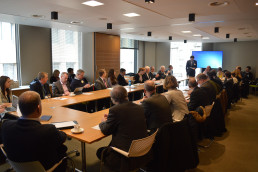
15th Ethical Finance Round Table Focuses on Millennial Perspectives in Finance
The latest Edinburgh Ethical Finance Round Table took place for a second time in the offices of Baillie Gifford. The topic for the meeting was the attitude of the millennial generation to finance and their potential influence on investment decisions. In a departure from the established format the meeting featured presentations from four speakers

The first presentation was given by Iona Bain, a freelance financial journalist who has established a leading media profile in this area, not least as founder of “Young Money Blog”. Her own view was that “millennial” was something of misnomer and in danger of becoming little more than a marketing concept, but nevertheless had become the established term for those in the 20-35 age group. While she questioned whether this generation is truly more entrepreneurial that its predecessors, there was no doubt that technology had changed attitudes and this age group very much wished to handle its finances by smartphone. So far this was largely confined to bank account operation as “fintech” was still not a widely understood term - this was likely to change however. She did consider that her generation was driven more by its ideals and social goals than purely questions of income and the fact that the general expectation was now to change job every three to four years meant that traditional pension structures etc were not well aligned. One particular concern to her was the apparent investment gap between men and women even in this age group, which in her opinion risked a “gender prosperity gap” developing.

The second speaker was Laura Westring who, following a career with the EU, was now Head of Communications at “FutureX”, founded last year to support young entrepreneurs and early stage businesses in Scotland. Her main reason for returning to Scotland had been the substantial growth in business start-ups, particularly in the area of fintech – Edinburgh now hosts the largest technology start-up hub in the UK. One important change in attitude which she had detected was that start-up business owners and their funders were less interested in the old model of building up the business with a view to an early exit than in maintaining control and involvement through alternative financing routes such as crowdfunding. Another significant development was the growth in promoting staff retention and commitment by providing opportunities for investing in the businesses concerned. In some cases, if entrepreneurs can show a convincing early track record they can hand pick their investors for their attitude and commitment to the business in question. One important aim of FutureX is to bring together entrepreneurs who might otherwise consider themselves competitors with a view to learning from each other and sharing ideas from which they can all benefit.
In response to a question from the floor as to whether she thought millennials are more “ethical” than previous generations, Laura responded that while that might be debatable she did think they were more open to risk-taking, due to the decline in job security and long term employment.

The next speaker was Dave Gorman, the Director of Social Responsibility and Sustainability at the University of Edinburgh. He set out the background to the University’s “Responsible Investment Policy”, which had been in place since 2013, with the practical consequence that investment decisions were now driven as much by “ethical” questions such as supply chains as by purely financial considerations. An annual survey was conducted with the student body, which generally produced around 4,000 replies. One general change of mindset he noted was moving on from identifying problems to focusing on solutions. Ideas about the purpose of investment had also widened and could be tied in with the University’s own work – e.g. social enterprise investment being linked with teaching and research projects.
Graham Burnside in the Chair introduced the final part of the meeting by summarising briefly the current inter-faith finance project taking place between the UKIFC and the Church of Scotland, seeking to agree a framework of shared values in the area of finance and economics and to move on from that to develop a practical financial product reflecting these values.

This then led into a final presentation from Martin Palmer, the Secretary General of The Alliance of Religions and Conservation (ARC), which works with all of the major faiths. Martin emphasised that the ARC’s work was not about inter-faith dialogue as such, but rather bringing the diverse faith groups together to work on non-religious issues, particularly on investment and environmental matters. Over 75% of faith groups now have negative screening processes in place but until very recently almost none had any positive investment policies. ARC was now working to create a “Faith Consistent Investment Alliance” to encourage and develop moves in this direction. Another important recent development is that the ARC and its associated faith groups are working with the UN on promoting its Sustainable Development Goals.

'How Ethical is Islamic Finance' Thematic Workshop a huge success!
We are pleased to announce that our Thematic Workshop with the International Shari’ah Research Academy for Islamic Finance (ISRA) in association with K&L Gates had a great turnout and was a huge success. There was a lot of passion, energy, provocation and engagement with the topics. More details about the thematic workshop will be published soon.