

UKIFC hosts impact investing round table
The 12th Edinburgh Ethical Finance Round Table once again took place in the offices of Maclay Murray & Spens LLP. Picking up on themes from the previous meeting, the topic was Impact Investment and how its outcomes can best be evaluated.
 Amanda Young, who heads the Responsible Investments team at Standard Life Investments, gave the first presentation. Outlining the history of the ethical investment movement over the past 25 years she indicated how this had moved from purely negative screening to an active scrutiny of the social/environment returns from investments alongside the financial ones. Currently the main barrier to larger scale involvement from mainstream investors is the limited size and scale of investment opportunities, but she saw encouraging trends which should help to counter this – government pressure on businesses to report on these issues and at an international level the increasing acceptance of the UN Sustainable Development Goals were examples of important factors. Standard Life Investments’ own approach involves building an “impact stock universe” from its overall “buy” list of around 150 stocks. She emphasised that key factors were measurability and intentionality – evaluation of these is very much a developing process but there is a continuing focus on seeking to refine this.
The second presentation was given by Celia Tennant, CEO of Inspiring Scotland, which deals exclusively with philanthropic impact investment. Celia indicated that their focus was almost entirely on social impact, their process starting from identification of a social need around which they then raise funds and seek to identify a portfolio of the best placed third sector bodies to tackle the issue. The aim of venture philanthropy is to make an impact and share the outcomes and accordingly evaluation and measurement of these is essential, for which they use both internal and external assessors. To date Inspiring Scotland has donated over £100m to the Scottish voluntary sector spread over 300+ organisations.
A general discussion followed, focusing initially on the issue of whether a sufficient scale of qualifying bu sinesses to allow impact investment to “go mainstream” is likely to emerge. The view on this was cautiously optimistic, pointing to the faster than expected rate of change in for example the development of electric cars and the growth of Green Bonds. Amanda Young did however see a considerable challenge in building platforms which would allow retail investors easy access to impact investment. On the question on measurement there was general recognition that this imposed onerous requirements on businesses but was nevertheless essential for development and signs were that mainstream organisations were increasingly accepting the requirement. There was consensus that continued focus on agreeing common approaches to evaluation and transparency of outcomes was essential and it was noted that the UK is leading internationally on measuring environmental impact.
The meeting concluded with a brief update on the Ethical Finance Hub project from Julian Parrott of Ethical Futures. The main recent development was securing premises at the Edinburgh Business School, Heriot-Watt University. The next crucial step was achieving confirmation of continued financial support from Scottish Government and it was hoped that this would be confirmed within the next month.


UKIFC Promote Public Lecture in Islamic FinTech at UEL
The UKIFC is delighted to be supporting the University of East of England public lecture on Islamic finance which this year will be themed around the Shariah and regulatory aspects of FinTech.
FinTech is disruptive. Existing regulations do not fit well with new products. "Islamic" FinTech adds the requirement of Shariah compliance to the legal complexity of financial innovations. Islamic jurists and Shariah standard setters have not yet systematically dealt with issues such as "cryptocurrencies," risk mitigation in crowdfunding, smart contracts, or the status of decentralised autonomous organisations (DAOs). Is there a need for "Shariah sandboxes" to reduce Shariah non-compliance risks for innovators?
EVENT DETAILS
Date / Time:
6:30-8:00pm, Wednesday February 22, 2017
Venue:
University of East London
Main Lecture Theatre, University Square Stratford
No 1, Salway Road, Stratford, London E15 1NF (five minutes walk from Stratford tube station)
Speaker:
Prof. Volker Nienhaus
Dr. Volker Nienhaus was a Professor of Economics at the University of Bochum and President of the University of Marburg. Currently, he is Adjunct Professor at the International Centre for Education in Islamic Finance (INCEIF) in Malaysia, consultant to the Islamic Financial Services Board (IFSB) and a member of the International Advisory Panel of the World Islamic Economic Forum (WIEF).
Chair:
The Hon. Mr. Justice Cranston
High Court Judge, Queen’s Bench Division
Attend:
Event is free and on first come, first served basis. For enquiries, please email S.Sait@uel.ac.uk

UK’s largest Islamic retail bank opens its first office in Scotland
Al Rayan Bank has opened an office in Glasgow, establishing its presence as the only wholly Sharia compliant retail bank in Scotland and further cementing the country’s reputation as a hub for ethical finance. The office will be officially opened this evening by Al Rayan Bank’s Chief Executive Officer, Sultan Choudhury, and Chief Commercial Officer, Keith Leach, together with key members of the Bank’s executive team.
Cabinet Secretary for Economy, Jobs and Fair Work Keith Brown said: “Al Rayan Bank’s welcome decision to expand its operations into Scotland for the first time highlights the real opportunity offered by ethical finance. This announcement reflects Scotland’s growing profile in ethical finance, building on last year’s successful Global Ethical Finance Forum and the work being done by the Edinburgh-based Ethical Finance Hub. I wish them all the best for a successful future in Scotland.”
Scottish customers will now have access to the UK’s largest range of Islamic retail banking products. This includes Sharia compliant home and property finance products that are tailored to the Scottish market; savings accounts; current accounts and business banking. In addition, the Bank accredits Sharia compliant pensions and investment products, which are provided by third parties.
Although specialising in Islamic finance, Al Rayan Bank is an inclusive bank which welcomes customers of all faiths. Throughout the UK, non-Muslim customers are increasingly choosing it as their bank of choice. The Bank estimates that 94% of all Fixed Term Deposit (FTD) savings customers who have joined the Bank this year were non-Muslim. These customers are attracted, not only by the ethical nature of Islamic finance, but also by Al Rayan Bank’s consistently table topping expected profit rates.
Sultan Choudhury, CEO, Al Rayan Bank, said: “Al Rayan Bank is committed to being an inherent part of the communities that we serve. We have many Scottish customers, who in the past have managed their accounts through our online and telephone banking channels, so it’s with a real sense of pride that we can now welcome existing and new customers to our first permanent office in Scotland.”
Scotland has a proud heritage in ethical finance, and the new office is co-located with the Islamic Finance Council UK (UKIFC), a well-established advisory and developmental body that specialises in promoting and enhancing the global Islamic and ethical finance industry. Omar Shaikh, Board Member, UKIFC, said: “We welcome Al Rayan Bank to our Glasgow offices, and look forward to working in partnership with them. We believe that Al Rayan Bank’s new office is great news for Scotland, as the Bank provides consumers with a competitive, ethical alternative to traditional banking.”
The new Glasgow office forms part of Al Rayan Bank’s national branch and office network, which is strategically located throughout major cities in the UK.
Al Rayan Bank is authorised by the Prudential Regulation Authority, regulated by the Financial Conduct Authority and the Prudential Regulation Authority, and is a member of Financial Services Compensation Scheme.

Omar Shaikh Participates in UN Event in Turkey
UKIFC Advisory Board member Omar Shaikh was invited to participate in a prestigious panel on Islamic finance and impact investing at the United Nations Development Programme’s (UNDP) Istanbul International Centre for Private Sector in Development's (IICPSD) 7th Bosphorus Summit which took place on 29th November 2016.
IICPSD is one of six UNDP global policy centres with a special mandate to focus on the role of the private sector in development. Recently UNDP IICPSD and IDB established the Global Islamic Finance and Impact Investing Platform (GIFIIP) to support the implementation of the 2030 Agenda for Sustainable Development and its 17 Sustainable Development Goals.
Omar was able to share insights on Islamic finance and social impact while moderating the "Towards an Islamic Finance and Impact investing Ecosystem" panel session. The panel brought together the experience of practitioners and investors focused on scaling up Islamic finance for impact investing. The discussions sought to identify future directions for a global Islamic finance and impact investing business ecosystem in support of the Sustainable Development Goals. Speakers for the sessions were:
- Kıvanç Çubukçu, Project Manager, Kois Invest, Belgium
- Prof. Abdul Ghafar Ismail, Head of Division, Islamic Banking and Financial Economics & Islamic Research and Training Institute, Islamic Development Bank, KSA
- Hussam Abu Issa, Vice President, Salam International, Qatar
- Aamir Abdul Rehman, Managing Director, Fajr Capital, UAE
- Dr. Serdar Sümer, CEO, Aktif Bank, Turkey
- Babur Tolbayev, CEO, Mol Bulak, Kyrgyzstan
- Ufuk Uyan, General Manager, Kuveyt Türk, Turkey
The Honorary Opening Speech was delivered by Recep Tayyip Erdoğan, President of the Republic of Turkey.

UKIFC and ISRA conference on Shariah Goverenance
Deputy Governor of the State Bank of Pakistan and leading international shariah scholars and industry experts convene in London (Oct16)
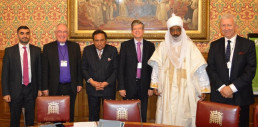
Archbishop supports shared values discussion at House of Lords
A world leading interfaith initiative aimed at creating a practical ethical financial solution will move a step closer on Monday (24th October 2016) at a private round table to be held in the House of Lords in London. The Church of Scotland and the Islamic Finance Council UK (UKIFC) are convening a unique gathering of faith leaders, parliamentarians, and finance practitioners to agree a shared values framework upon which a financial solution, open to all in society, will be developed.
The joint venture, the culmination of many years of dialogue, was launched earlier this year in response to the systemic failure and non-sustainability of the current financial model that has struggled to recover from the economic, operational and reputational damage caused by the global crisis in 2008/09. By developing a pioneering new model of interfaith engagement the initiative aims to move from dialogue to action by creating a fairer, more socially responsible financial system.
According to the Rev Dr Richard Frazer, convener of the Church of Scotland’s Church & Society Council: “Two of the most important tasks that we face as a society are developing a fairer and more sustainable economy – one which has a passion for equality at its heart – and building stronger relationships across faith communities. This initiative does both and it is hugely exciting to be a part of it.”
The event is the second in a series of three workshops. The first, held in Edinburgh in May 2016, reviewed the theological and philosophical underpinnings of Christianity and Islam in order to identify commonalities. Shared values identified during the discussions included: our role as stewards on a planet with limited natural resources, tackling excess and greed and encouraging moral responsibility.
At the House of Lords workshop on Monday the shared values framework will be reviewed and refined before participants explore the practical obstacles to realising a vision of ethical finance today. Leading asset managers, banks and economists will share their insights on different types of economic models where ethical finance deepens the economy, encourages inclusion and creates positive social impact.
Omar Shaikh of the UKIFC commented: “We are delighted with the positive response received from parliamentarians and practitioners which reinforces the significance of this initiative. Bringing the debate to the heart of London, a leading a global financial centre, sends a strong international message that faith communities can work together for the greater good of society.”
The initiative emerged from the UKIFC Interfaith Ethical Finance Roundtable, attended by the Archbishop of Canterbury Justin Welby, in 2013 and the Church of England continues to take an active involvement.
“The need for a fairer, more ethical banking system has never been more pressing. What emerged clearly in 2013 is that those from faith perspectives have an important contribution to make in creating a shared solution for the industry and the communities that they serve. I look forward to seeing this discussion continue to evolve in the months and years ahead.” Edward Mason, Church of England.
It is expected that the shared values framework, the first of its kind globally, will be announced early next year, informing the development of a viable ethical finance business solution.
For more information contact:
Chris Tait, Islamic Finance Council UK
(m) 07931103573
Rob Flett, Communications Manager, Church of Scotland
rflett@churchofscotland.org.uk
(m) 07764 335793
About the Islamic Finance Council UK
The UKIFC was established in 2005 as a specialist advisory and developmental body focused on promoting and enhancing the global Islamic and ethical finance industry. As a dynamic and forward-thinking not-for-profit organisation the UKIFC’s Advisory Board Members, who provide pro bono support, have defined and evolved the role the organisation plays in making a tangible impact in the global Islamic and ethical finance sectors. Principle service areas are: Advisory, Ethical Finance, Training and Awareness and Thought Leadership.
The UKIFC has been recognised globally for its work in promoting shared values and increasing connectivity between ethical and Islamic finance stakeholders across the UK. For more than 5 years the UKIFC has been leading an award winning debate on ethical finance through a series of events based in Edinburgh.
About the Church of Scotland
The Church of Scotland is Scotland’s national church and is also one of the UK’s largest charities. It serves almost 400,000 members, with more regularly involved in local congregations and our community work. Within the organisation, the Church has around 800 ministers serving in parishes and chaplaincies, supported by professional and administrative staff. The Church has a proud tradition of working to benefit those less well off in society, and campaigns on a range of economic and social welfare issues.
END.
UKIFC and ISRA Launch ‘External Shari’ah Audit Report’
A pioneering report calling for an independent audit of Shari’ah compliance in Islamic finance will be launched today at the Global Islamic Economy Summit in Dubai.
Following consultation with over 35 practitioners across four countries the Islamic Finance Council UK (UKIFC) and International Shari’ah Research Academy for Islamic Finance (ISRA) unveiled the ‘External Shari’ah Audit Report’, which seeks to strengthen Shari’ah assurance and calls for external Shari’ah auditing to be made mandatory in Islamic financial institutions across the globe.
With consumer and regulatory demands increasingly focusing on trust, transparency and accountability corporate governance has become a critical challenge for all financial institutions. In particular, this trend has shone a light on Islamic financial institutions, where in-house boards of scholars effectively self-regulate Shari’ah compliance, raising questions as to whether the current model of governance is fit for purpose.
The report, which reflects recent developments in international policies and regulation, proposes that external Shari’ah audit, requiring Islamic financial institutions to undertake an annual Shari’ah audit by a competent independent party, should become an essential development for the industry to augment the work currently done by Shari’ah boards.
Omar Shaikh, Advisory Board member of UKIFC commented: “Ensuring and maintaining the integrity of the Shari’ah is paramount to sustaining future confidence and growth in the Islamic finance sector. By providing an additional check, external Shari’ah audit will play an important role towards providing reassurance to scholars, financial institutions and customers.”
The report also provides a jurisdictional analysis of current external Shari’ah auditing requirements in Oman and Pakistan, where it has already become mandatory.
Prof. Dr Akram Laldin, Executive Director of ISRA added, “Various initiatives are being taken in different jurisdictions to ensure compliance and maintain the credibility of Islamic finance among stakeholders. External Shariah audit provides additional assurance and it does so with greater independence than others.”
Bahrain looks set to be the next jurisdiction to adopt external Shari’ah audit regulation with the Central Bank of Bahrain recently issuing a consultation paper on their proposals. Dr. Ahmed Abdul Hameed AlShaikh, The Deputy Director of the of Bahrain Institute of Banking & Finance commented, “We strongly believe that the next step in creating robustness in this industry and in safeguarding all relevant stakeholders is an appropriate external Shari’ah audit framework— which many central banks, including the Central Bank of Bahrain, are considering introducing in the near future.”
The report also focuses on implementation issues, providing specific recommendations on the role of central bank Shari’ah boards, requirements for public reporting, qualification of external Shari’ah auditors and the need for a professional body for Shari’ah scholars in Islamic finance.
Yasser S. Dahlawi, CEO of Shariyah Review Bureau concluded, “There is hardly a more important subject in the field of Islamic finance than external Shari’ah audit. As the industry undergoes change, this is the right time to report on something new: a new auditing framework, a new reporting mechanism, and new regulatory mandates. This is because a growing industry needs robust supervision to ensure its positive growth and future progress.”
The e-version of ‘External Shari’ah Audit Report’ can be found at alasdairc15.sg-host.com and isra.my
For more information contact:
Chris Tait, Islamic Finance Council UK
(Tel) 0044 7931103573 or 0044 7193 6329
Mezbah Uddin Ahmed, ISRA
(Tel) 00603 76514224
About
Islamic Finance Council UK (UKIFC)
The UKIFC is a specialist advisory and development body focused on promoting and enhancing the global Islamic and ethical finance industry. The organisation was launched in 2005 by a group of likeminded professionals who sought to make a contribution to the development of the Islamic finance industry. The UKIFC specialises in four core areas, being:1) Ethical finance – helping to promote better co-ordination and understanding of the shared values between Islamic finance and the broader ethical finance arena; 2) Advisory – specialist capability in advising government agencies, regulatory bodies and financial institutions on creating enabling frameworks for Islamic finance; 3) Executive training – delivering bespoke capacity building programmes aimed at practitioners and regulators focused on commercial issues; and 4) Thought leadership – authoring reports, community education and providing industry comment towards influencing regulation and encouraging the development of the sector based on strong research and insights.
International Shari’ah Research Academy for Islamic Finance (ISRA)
ISRA is an autonomous body set-up under the direction of the Central Bank of Malaysia (Bank Negara Malaysia) to promote applied research in the area of Shari’ah and Islamic finance. ISRA contributes towards strengthening human capital development and provides a platform for greater engagement amongst practitioners, scholars, regulators and academicians via research and dialogue, in both the domestic and international arenas. Through pioneering research and rigorous intellectual dialogue, ISRA aims to promote innovation and dynamism and thus extend the boundaries of Islamic finance.

Digital Banking - Fintech future for Islamic finance
UKIFC Board Members join ADIB CEO at RFi Group digital banking event in Dubai.

HH Emir Sanusi delivers keynote at Shared Values workshop
On the 28th of May 2016, the IFC together with the Church of Scotland held the first in its three part workshop series to identify a ethical finance shared values principles framework.
Held at the Dalmahoy Estate, the round table workshop bought together leading global theologians, scholars and practitioners and follows the joint venture announcement made earlier in the year (see FT / BBC coverage). The first workshop took a historical perspective to explore the events, people and ideas that have shaped faith discussions on ethical finance. Along with the key note from HH Emir Sanusi, presentations were made by , Rev. Richard Fraser, Sheikh Ruzwan, Prof. Robbie Mochrie and Dr Akram Laldin.
The content revolved around an enquiry on the following points:
- Theological perspectives on ethical finance and just economy.
- Philosophical underpinnings of ethical finance.
- The teleology of economy in Christianity and Islam.
- Mapping a history of the ethical finance movement in relation to the religious teachings that informed it.
- The socio-theological origins of Savings Banks movement in Scotland.
- Contextual factors to the rise of alternative financial models and the role of Christianity and Islam in facilitating such initiatives.
The next round table workshop is planned for later in the year in London. To find out more or to participate contact info@ukifc.com

Umer Suleman recognised as a ‘Rising Star of the City’
The Top 30 future leading figures in the City were recognised and celebrated in this years Brummell publication. A rigorous judging panel reviews nominations and this year Umer Suleman was successfully recognised for outperforming in his market and for giving back to make the world a better place.
As noted in Brummell, ‘Suleman is an experienced risk SME who has assumed various risk roles during his career. He co-heads HSBC’s Muslim Network and used his experience to run a workshop on leadership and creating effective networks for City employees. He is an executive manager for the Islamic Finance Council on a pro-bono basis and one of the founding partners of Affogato, an ethical artisanal coffee and gelato shop. He previously took a sabbatical to join the Mosaic charity, which helps people from disadvantaged backgrounds.‘
for more information click here